Yelp: The Local Business Secret Weapon

YelpTwo weeks ago Reno’s Yelp Community Manager, Michael Tragash, came to speak to my personal branding class. While I use Yelp several times a month to look for reviews, I never thought about the power it held to help small businesses. That changed at the beginning of Michael’s presentation with the following statement, “The mission of Yelp is to connect individuals with great local businesses.” His presentation confirmed that statement for me and I wanted to find out more.

I was able to follow-up with Michael one-on-one and he made me a true believer. As a business development advisor with the Nevada Small Business Development Center, I am constantly looking for new ways to help my clients. I learned that Yelp is a full member of the Social Age and provides people a truly useful tool; for individuals and businesses. My biggest takeaways from the conversation are below:

  1. What is Yelp at its core and how does it impact the community?

Yelp is really about connecting individuals with local businesses. The initial tagline was “real people, real reviews,” and it is those real people who share the reviews, photos, and tips that help connect users and visitors to great local businesses. Yelp is now the real-time platform for customers to give and receive reviews. If you use the site and/or app effectively, there is no longer a need to buy a city’s review book.

New businesses rotate on each community’s homepage, which is free advertising directly to individuals looking for a new experience. Locally, Yelp also puts out a weekly newsletter that features local businesses and is distributed to an impressive subscriber base in the Reno/Sparks area This is an immensely powerful tool available in each major community around the country. However, the only way to take advantage of these free resources is if the business owner is proactive and deliberate about social media and Yelp.

There are constantly conversations about local businesses going on, sometimes critical, and these conversations have a real impact. As an example, Michael found a new Chinese restaurant in town that had been highlighted on the homepage of Yelp as one of the “New Businesses In Reno”. Within a few days, the business – which had really done a good job updating their page – went from 3 reviews to almost 20. That is a HUGE impact and shows the immense power Yelp has to influence decisions.

  1. What does a business owner need to do regarding Yelp?

Michael had three main suggestions. The first is to simply claim the page. This is an easy process and allows a business owner greater control over their brand and ability to interact with customers. Second, post relevant photos of the business, along with populating as much of the business profile as possible. Doing this puts the business owner in the driver’s seat and projects more professional content. The benefits in doing this can be seen through the data; people spend 2.5 times longer and pages with photos, according to Michael. And third, promote that the business is on Yelp; a sign out front, table tents, information at the register, links on other social media sites, etc.This will be the best way to get unsolicited Yelp reviews and becomes the new comment card.

The benefits of these action allows the business owner to boost their social media presence. It is likely that Yelp will come up higher than even the company website in Google. By linking the business website to all of the social media platforms, and posting reviews from each, will boost SEO. There are so many ways to use Yelp as a launch pad for social media marketing and Michael is always willing to discuss how a business can make the most of Yelp. Those who have a negative or neutral view of Yelp should especially reach out to Michael to learn more about how to maximize the opportunity. Regardless of your sentiments on social media, customers are talking about businesses online, and Yelp is an opportunity for business owners to participate in those conversations.

  1. What do business owners need to avoid doing on Yelp?

There are also several “don’ts” on Yelp. It is important to understand the power of Yelp is in building trust through real people giving real reviews. Promoting anything counter to that message should be avoided; such as incentivizing reviews. It is also a platform to respond to negative customer experiences, but should be done in a professional manner; don’t be reactionary and make sure the message is well crafted. Finally, don’t forget to use the business owner tools available to help track and respond to information.

  1. Quotes from Michael that made the biggest impact on me.
  • Out-of-towners make decisions about where to spend their time and money while traveling. Locals have the ability (and responsibility) to promote small businesses by sharing honest reviews that will drive traffic.
  • Yelp gives business owners a platform to receive valuable information that allows them to understand what they’re doing well and not so well in order to make improvements. Owners can also respond directly to customers using the tools in the Free Business Owner Account.
  • Yelp helps businesses to connect with customers after they’ve left the establishment. Public comments or private messages from business owners can be powerful tools when used properly, creating a dialogue with Yelpers that can result in review updates and opportunities to see those who said they would never return back for another try.
  • Trust is our top concern, and there has never been any amount of money a business could pay Yelp to alter or remove reviews. Yelp also doesn’t skew anything in favor of advertisers or against those who do not.
  • The Yelp logo is sort of like a dog whistle for customers at this point. Businesses don’t need to ask for reviews, but rather just let customers know that you value their presence. The reviews and photos will follow, starting dialogue within the Yelp community.

Talking to Michael was truly eye-opening about what Yelp can actually do for local businesses and its impact on the community as a whole. If you are a business owner, or work at an establishment, that has not fully embraced Yelp, reach out to Michael on his Yelp page. Taking a little bit of time to use this free resource should be a priority.

Image Credit

Making Your Business Plan Work For You

One of the most important aspects of my job is to review business plans for clients. Essentially looking into the soul of what their business will become. This has given me a great perspective on the importance of the business plan, but also the mindset many people have towards them. A common belief is that a business plan is only a tool to receive a loan; banks want to see real information before just handing out money. However, not all businesses require a loan when starting up. That doesn’t mean a startup, or business planning to expand, should move forward without creating a business plan.

Business_Plan

There are tremendous benefits in having a business plan that can directly lead to long-term success; it is a major piece that will make up the foundation of the business. If real effort is put in, then the business owner should be armed with the information to know exactly where success can be found. That doesn’t mean there won’t be changes and lessons learned along the way, but having a road-map makes getting to a destination that much more likely. Additionally, spending the time on a business plan can even show that opening the business is a bad idea; for a number of reasons. That is valuable information to know before much, if any, money is actually spent.

In the process of writing the plan, there are several sections, along with the process itself, which I believe can make the difference between profitability and closing the doors. Below is a list of each and what I feel they provide.

The Plan

  1. Industry/Market Analysis: The first question this section should answer is the level of completion in the market. It can also give insights into where to open as it should show any under-served area.
  2. Marketing Plan: How will this business be different? Why would a customer come here instead of any number of other places? These questions must be answers, along with how customers will be made aware of the business and be transitioned from a consumer to a customer.
  3. Financial Projections: This may be the most important section connected to ensuring profitability. If the numbers don’t add up or 1000 customers a day would be required to break-even, then real consideration must be given to making major changes to the business model.

The Process

  1. Making calls: By simply making calls to get quotes, ask questions, and talk to those already in the industry, contacts will be made and valuable information will be gathered. This includes actually getting a quote for pretty much everything needed in the business; such as insurance, products, and supplies. Calls also provide the opportunity to ask questions from those who are experts in the field. Never be surprised when an amazing new insight is discovered through these conversations.
  2. Looking at the competition: By doing market analysis, a clear picture should emerge about the competition, who they are and what they are doing. This is important because it can show what is successful, but also what needs to be done to be different.

All of these sections have way more involved than what I have listed, but I tried to capture the main ideas. The last item, that is not usually part of the business plan, but I feel is vitally important, is the action plan. For some, this may come in the form of a timeline, but having this plan can help ensure everything that must be done is accomplished. When starting a business, many variables exist that take time and there has to be an effective way to track them and create accountability.

The business plan is one of the most important aspects of starting or expanding a business, and I believe it should become the journal of the business over time. That doesn’t mean rewriting each section as things change, rather adding in a page in the back with new information that is valuable; new marketing strategies, better accounting practices, customer demographic information, etc. This will always be helpful if a loan is needed to expand the business, as well as being a how-to manual for creating any new venture. There is no such thing as too much information.

The bottom line is that the process of writing the business plan is almost more important than the plan itself. With that in mind, what other section do you feel can make the difference between success and potential failure? Please leave your thoughts in a comment below.

Image Created By Author

The Race is On: Creating the Reno-Tahoe Odyssey

Part II of my interview with Race178 President and Reno-Tahoe Odyssey Race Director, Eric Lerude.

RTO-logo-2015Starting any business will have its own unique set of challenges. There are many factors that need to be put in place in order to enhance the possibilities for success. One of the most difficult is when there is a requirement for a high volume of customers on day one. That is what Eric Lerude set out to do when he created the Reno-Tahoe Odyssey (RTO), a 178 mile relay race around Reno and Lake Tahoe.

Eric formed Race178 as the overarching business that would put on the RTO and other events. You can read about how the first race came to be by clicking over to part I of my interview. The RTO was born from a desire to showcase the beauty of the Reno-Tahoe area though an experience focused on a healthy lifestyle. Thousands of dollars are infused into the local economy with teams coming from all over the country, and even some from abroad, for the two-day event. In addition, donations are made each year to local charities, including the Northern Nevada Children’s Cancer Foundation and the Tahoe-Pyramid Bikeway.

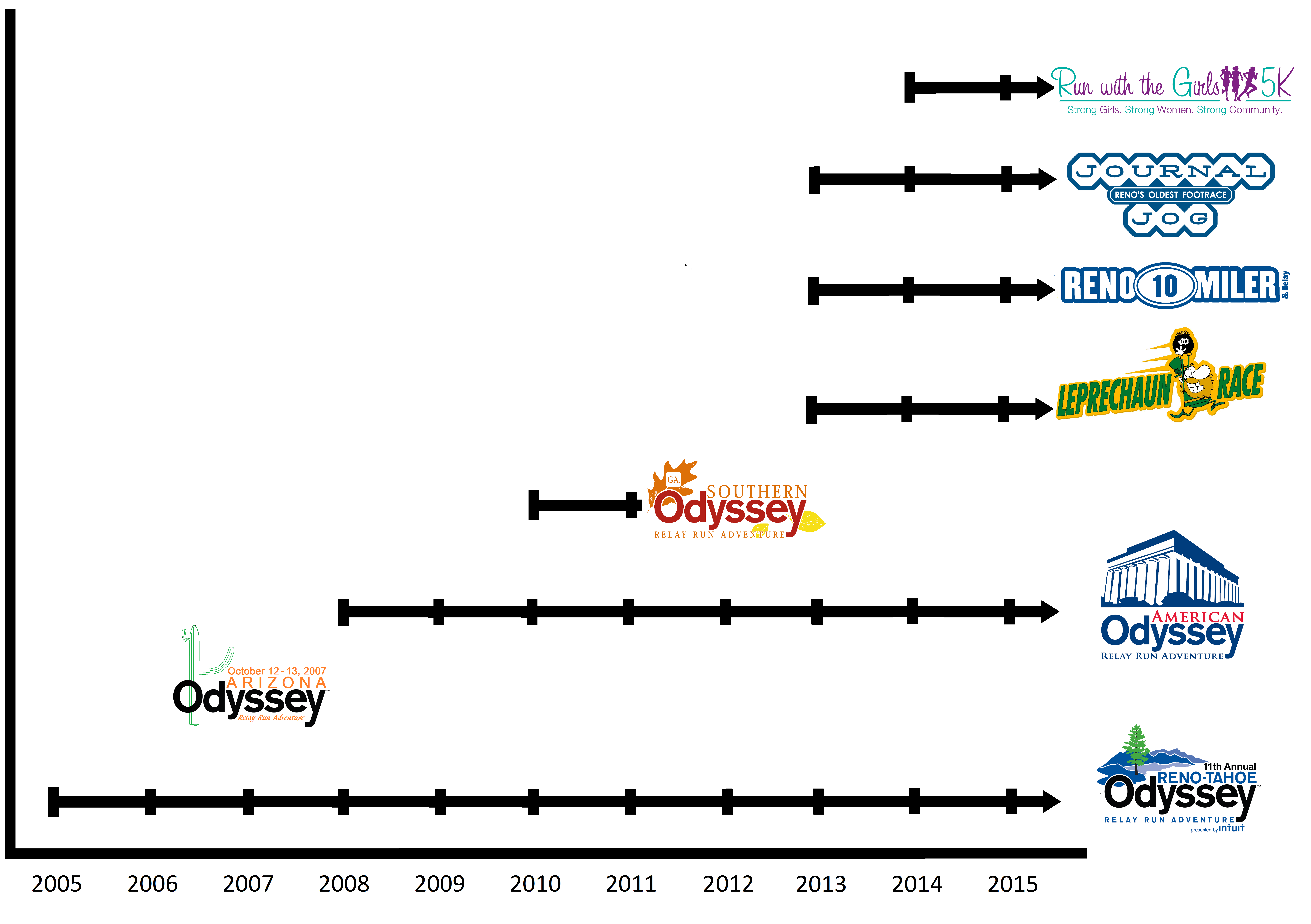
About to enter its 11th year, the RTO will have the self-imposed cap of 250 teams, over 3000 runners, traversing the course. However, not all of the events that Race178 has put on have continued with such success. As Eric puts it, “Life is a journey and you won’t have a straight dotted line to success. RTO TimelineYour path has some left and right turns, which can be good things.” By looking at the graph, there have been several races that have come and gone. The Arizona and Southern Odyssey’s were not able to attract a consistent following and were discontinued. Several other races, including a few abroad, were investigated, but there were clear indications that success would be unlikely. With each race and investigation, new lessons were learned and wise business decisions were made in order to prevent overextending Race178.

The success for the first RTO in 2005 was not just something that happened. A tremendous amount of effort was placed on getting the original 36 teams. Eric attended trade shows, went to running stores and applied for grants to help the race become a reality. “You have to put yourself out there and take some chances along the way. Only when you have started going down the path can you see the next opportunity.” Case in point, Eric told me the story of how attending one of those trade shows is where he met his future partner in the American Odyssey, held in Washington D.C.

There were several other valuable lessons Eric shared with me, which are below.

  • Trial and error was a big part of starting out.
    • Learn from the good ones and the bad ones.
  • You have to be authentic and like what you are doing.
  • It is all about customer service. Being able to genuinely connect with customers.
  • Grow your business in a measured way.
    • Deliver on what you know you can deliver.
    • Always under promise and over deliver.
    • Start simple and add the bells and whistles later.
  • Personally respond to emails.
  • If there are issues, try to be in the customer solutions business.
  • Deliver on the product and have customers make sales for you through social media.
    • We haven’t spent much on advertising because word-of-mouth has grown RTO organically.

In today’s world, running events are part of a very competitive industry, with a large amount of 5ks, mud runs, color runs and countless others. Despite this, Eric’s Race178 has created a model that has allowed for great success; focusing on the customer and providing a quality product.  Race178 now oversees the two Odyssey runs mentioned above, plus the Leprechaun Run, Reno 10 Miler, Journal Jog and Run with the Girls 5K. Eric has distinguished himself in the running community and the future is wide open for other events that may become part of the fold.

Visit their website to learn more about each event Race178 puts on. And, make sure you put next year’s RTO on your calendar to sign up before it fills up.

Image Credit – Graph created by author

Course Correction: Changing Careers

Part I of my interview with Race178 President and Reno-Tahoe Odyssey Race Director, Eric Lerude.

Race178One of the most important, and sometimes most difficult, decisions in our lives is determining what career path to choose. In our teens this decision first makes an appearance when we decide where to attend college and what major to pursue. Then we go after our first job in our early 20’s and by the time we are 30 we have almost a decade of experience. With every passing year, the risk of making changes becomes greater and greater; not only for the career, but also factoring in elements like a spouse and kids.

This was the decision Eric Lerude made in 2005. Having majored in finance and then passing the bar following law school graduation, Eric was a well-established attorney with 15 years of experience. However, having selected law school under the assumption that being a lawyer was a good job, he never found an intense sense of satisfaction from his work. That changed in August of 2003 when Eric ran the Hood to Coast relay race in Oregon. He had started running at a high level and this race was an opportunity to explore a new area. It ended up being the “ah ha” moment that changed his life.

Flying home, thoughts went through Eric’s mind about how he could create a similar experience that would showcase the city he was born and raised in, and loved – Reno. This was the moment of birth for what would become the Reno-Tahoe Odyssey (RTO), a 178 mile relay race around the city and lake (The full story of the RTO is in Part II). Suddenly, a new level of passion came over Eric like never before. This energy pushed him to spend the hours outside of his full-time job to pursue this new adventure.

Shortly thereafter, the moment came when Eric had to make the big decision; continue full-time as an attorney or take the risk and more full force into being a race director. This was an easy decision, especially with the complete support of his family. After hundreds of hours acquiring permits, working with the city, applying for grants, marketing, creating a business and doing a little bit of law work on the side, the first Reno-Tahoe Odyssey was ready to go.

10 RTO’s later and the 11th coming up soon, Eric’s transition has not only been successful, but tremendously rewarding. It is easy to see and hear the immense passion Eric has for his new career. Being able to authentically connect with others, centered on living a healthy lifestyle, generates even more passion and drive. Looking back, Eric shared the lessons he learned.

  1. In making a career change, ensure it is what you have a passion for.
  2. Leverage the knowledge and experience you have gained as much as possible.
  3. Support from those around you is an important element that can make the difference.
  4. And the most important lesson, “There is no magic pill.” Changing careers requires a tremendous amount of work and effort. Take advantage of classes, advisors and/or consultants who can help to make this transition easier. You don’t have to do it alone.

Making a career change should not be done lightly and only after many discussions with family, friends, mentors and professionals who understand the path you are looking to take. While there can be great risk, I feel that passion and dedication towards a goal is a potent combination for achieving success. Eric used his passion to achieve his goal and is now planning the 11th RTO, along with several other races he now coordinates. The lesson I took away from my conversation with Eric is to go after what drives you, using your passion and dedication to help find success.

Check out the Race178 website to see all the races Eric puts on and think about signing up for one!

Image Credit

The Service Profit Chain: It Is Only Step 1

My journey of going back to school began with the desire to add detailed academic knowledge to compliment the skills I have developed thus far in my career. Now, deep into my second semester, it seems as though I walk away from each class with a new tool to add to my tool-belt. Two concepts that were recently covered in my management class is the service profit chain and the misconceptions about monetary incentives. I feel these topics are intimately connected, so I decided to cover them together.

The service profit chain, in my opinion, has one vitally important takeaway. That is to take care of internal customers first – the employees. Below is a simplified graphic of the service profit chain. If employees are taken care of and have high job satisfaction, there is a trickle-down effect that leads to higher revenues. There is no one size fits all answer to have satisfied employees, but I believe it starts with creating a positive company culture. That culture starts from the top – the leadership and management. I will save the topic of creating a positive culture for another post, but the important item to remember is that a company must first take care of its employees.

Service Profit ChainThe question then becomes, how does a company do this? My answer is the second concept and why I felt the two topics needed to be combined.  Most companies assume that money is the motivator that will push individuals to do their very best and exceed expectations over the long haul. They would be wrong. This is not simply an opinion, but supported by many scientific findings from the last fifty years. Here is a great article from the Harvard Business Review, for those who need some convincing, which details the reasons why. While there may be short-term benefits, monetary incentives often produce unwanted or negative long-term effects.

So, if monetary incentives are not good for motivation, then what does it? Again, the answer is quite simple – it is intrinsic motivation. This is motivation derived though internal rewards. Daniel Pink does a great job of laying it out in a Ted Talk.

Then how can employee satisfaction be taken to its highest level? There is a much easier way to find out than spending thousands on consultants to provide a report on best practices, propriety research and the secret sauce. It is as simple as just asking employees what they want. They actually know what they would like as a reward when things go well. And, in my opinion, the best part of knowing what they want is that they can be given just that. Examples could include more social outings as a group, a gift card to a nice restaurant in town, wearing jeans on Friday, or even being able to get an afternoon off. Company leaders should not assume they know what employees want or what will satisfy them.

To sum everything up, remember that employees drive revenue, so make sure they are satisfied. Don’t assume the promise of monetary rewards will produce a desired result. And, to know what employees actually want, just ask them. I found these concepts very interesting and important factors to consider when advising clients and for future positions I will hold.

What would be something you would want as a reward from work? Please post your thoughts below.

Image Created By Author

Arte Nathan – Takeaways From a Killer Keynote

ArteI recently attended an awards banquet for the Nevada College of Business and the keynote speaker was Arte Nathan, Executive Director of Professional and Leadership Studies at UNLV. He was also the Chief Human Resources Officer at Wynn Resorts for over 20 years. After stating that he wasn’t going to read his original speech, Mr. Nathan began reviewing his professional journey and shared words of wisdom to the soon to be business graduates. Below are some of his quotes and my thoughts about each.

Resumes:

“You think we spend more than a minute looking at your resume?”

It is sad, but true. With the state of human resources today, there are too many resumes for too few jobs and there just isn’t time to effectively look at them all.

“The top line that says objective is what they look at. You’re supposed to know what your objective is.”

While I agree that having an objective is important on a resume, the idea here that struck me was being able to state your objective in the first place. I have had to state my own objectives, as most everyone has, and understood that having an objective doesn’t mean knowing exactly how you will get there. It is about having the goal and working to reach it.

“GPA doesn’t matter. You graduated. That’s what matters.”

For the most part, I agree with this statement. It is difficult to say that a GPA from one school is an accurate measure to compare against someone from another institution. This is not necessarily about the quality of the education, but the simple fact that the two systems are likely not the exact same.

“Your internship and attendance at the London School of Something or Other doesn’t matter. What matters is what you did when you weren’t studying. Those involved were holding offices and still graduated. They are multifaceted.”

While I don’t agree that internships and your institution don’t matter (and I don’t think Mr. Nathan does either based on his other comments), I do agree that what you do outside of the classroom can be more important than what you do in it. The reason for this is the application of what you have learned and the ability to build experience.

Life Advice – for Business:

“If you have a can-do attitude, you will go far.”

Attitude is one of the only aspects in our lives where everyone is on an equal playing field. By feeling and living the belief that you can get the job done shows confidence, and implementing that attitude will show your dependability and skills.

“If you never fail, you will never learn.”

While I don’t believe anyone sets out looking to fail, I do believe that if you haven’t failed, then you haven’t tried enough. Additionally, without failing, you will likely be ill-equipped do effectively respond when that inevitable time does comes.

~             ~             ~

It was reassuring to hear the words of Mr. Nathan as I share many of his beliefs and he has led a highly successful career. The three key elements I took away from his keynote were to know your objective, put your best foot forward and always be ready to learn.

Now, take a look at your own resume. Do you feel it puts your best foot forward? If not, make changes, ask others for their thoughts, get advice. For most of us, a resume is the first impression, so it is worth taking the time to make it count.

Image Credit

The Ozmen Center for Entrepreneurship

Leading the entrepreneurial lifestyle can be one of the most difficult, but also the most rewarding career paths to follow. Reno, Nevada is not the largest market in the country, but there is an incredible entrepreneurial culture within the city. In looking for some statistics on the subject, I ran across a blog listing several resources to assist area businesses and most are specifically focused on entrepreneurs. This shows Reno’s high level of commitment towards those efforts.

ozmencenterWorking at the Nevada Small Business Development Center (NSBDC), I see this culture every day. Not listed in the blog is a new resource, just down the hall from the NSBDC, the Ozmen Center for Entrepreneurship. The Center was established in the fall of 2014 through a generous gift by Eren and Fatih Ozmen; Nevada alumni and president and CEO, respectively, of Sierra Nevada Corporation. Sitting down with the Center’s Assistant Director and fellow MBA student, Kylie Rowe, I was able to get a detailed understanding of how the Ozmen Center stands out and has established itself as an excellent resource for the community.

The Ozmen Center is not meant to recreate anything that already exists in Reno as a competing endeavor, but focuses on promoting the entrepreneurial spirit on the University of Nevada campus. There are several ways the Center has already become a hub for activity and collaboration. It is where student entrepreneurs come to find resources and be directed to the best places to take their ideas, as well as hosting entrepreneurship club meetings and the livecast of Reno’s 1 Million Cups (something I try to take advantage of each week). These are just a few ways the Center is fostering the entrepreneurial community on campus.

In addition to helping students by providing space, direction and resources, Kylie and the Center have worked to expand the academic entrepreneurship courses offered. The entrepreneurship program, which includes a minor for undergraduates and an emphasis option within the MBA program, has been  expanded to include additional course offerings, such as entrepreneurial sales, and have been extremely popular. A certificate program in entrepreneurship is currently under development. While this may be seen by some as small additions, I believe the opportunity to understand entrepreneurship and foster the ideals behind it while still in school provides a tremendous advantage to those who will be the business leaders of tomorrow.

Working with entrepreneurs in my office, I see the benefits the Ozmen Center can have on the University community, as well as the Reno community. With a premier location and excellent team, the Center is in a fantastic position to help make a huge impact on the ability for young entrepreneurs to find success in their future efforts beyond the walls of the classroom at the University.

Click over to the Ozmen Center’s 2014 Annual Report to learn more about what they have accomplished and what they have in store for the future.

Image Credit

Youtility – Why Being Useful Matters

YoutilityOne of the current aspects of business I find most fascinating is the model used to deliver value to customers. It is always rolling around in the back of my head as a see an advertisement, walk through a store or read a review posted online. There is the old school notion of who and where customers are and how they interact with the world, and the new paradigm that has emerged with the dawn of the social media age. A book I just finished for a marketing class, Youtility by Jay Baer, is focused on the latter. The book details how companies are effectively promoting their brand through providing value to the public though, free, useful tools. This is an exciting concept that I had not thought about in this particular way.

Youtility is the idea of providing the market self-serve information, which is radically transparent and has real-time relevancy. An example the book gives that I found most interesting is Hilton’s @HiltonSuggests program on Twitter. Hilton simply offers recommendations to those who ask about things to do, see and eat in cities all around the world. This program lays the groundwork for maintaining current customers and can provide the tipping point for finally converting consumers. Hilton’s program successfully hits on all elements that make up Youtility.

Most everyone has heard of the Hilton brand, but this added element allows potential customers to connect with the company in a new way. On top of having a reputation for high-quality hotels, this useful tool allows customers and consumers to be given value, for free, when they need it. There were several other examples used, but this one stood out to me as a perfect representation the book’s point.

With each chapter I read, I kept trying to think about why more companies don’t have programs like this. There are many programs out there, but it is certainly nowhere near the norm. Author Jay Baer points out a few understandable reasons; the breadth of social media’ power is not fully understood by many, there is no direct measure of return on investment with these programs, and it is not clear who in a company is responsible for overseeing these programs. I believe it boils down to many people see the potential, but no one wants to take on the responsibilities because, at the end of the day, they will be evaluated on a program where the results are not clear.

Throughout the book, ideas came to mind on how I can promote Youtility. What I have come up with is offering a way for those who read my blog to request a topic that would help them in their professional life. So, I have created a Contanct Me page where anyone can send me an email to request a future blog topic.

Now think about how you, or your company, can implement Youtility to provide usefulness to consumers. Could it be providing free resources online or starting a YouTube channel with videos on using your product/service? There are so many possibilities, but it is vital to understand Youtility only works if it is what the public truly wants and they are able to find it. So, let the thinking begin…

To kick off my own attempt at Youtility, click over to Ask Me and let me know what you would like to read about in an upcoming post.

Image Credit

Starting a Business – One Martini at a Time

spicy-margarita-680x626Something that has always fascinated me about consulting is getting to work with a diverse array of clients who all have different needs. I find that being required to flex my creative and adaptive muscles is motivating. To have the best information to draw from, I attempt to learn from what I have done in the past, research what others have tried and, my favorite, learn from business owners who have done it themselves. By compiling this information, I have created my own library of best practices to draw from. To keep expanding this resource, I talk to as many people as I can.

I was recently introduced to Jessica Torres, co-founder of One Martini, a one-stop-shop for your creative cocktail needs. One Martini’s website content ranges from cocktail recipes to infused alcohols and spirit reviews to bar essentials. Jessica is a great example of a business owner finding success through adhering to simple, yet important, principles. Because of this, I was excited to be able to pick Jessica’s brain about her experiences in starting a blog and website. These are the highlights:

  1. I first asked Jessica what tipped the scale for turning her personal passion into a business and I couldn’t have received a better business-minded answer – “The fact that I could make money doing something I enjoyed.” Having passion for what you do is, in my opinion, a vital element needed for success as a business owner. The other side of this is understanding how to turn a hobby, idea, invention, etc. into a successful enterprise. The next response from Jessica is what helps to make that success a reality.
  1. Jessica mentioned that being open to change and not quitting were the most important lessons learned from getting the website to where it is today. Starting any business requires flexibility and perseverance, which can be some of the biggest hurdles to overcome. It usually comes down to accepting the need to adapt and having the grit to stick it out.
  1. When it comes to specifically overseeing a blog and website, Jessica had clear advice, “Running a blog/website takes a lot of time, especially in the beginning and it can take a long time to start seeing results from your efforts; stick with it, focus on quality content, photography and SEO. It’s also helpful to network and meet other people in the same niche as you. They are the ones who will promote you and help you grow.” While this may sound simple, many people overlook these critical points and it is where they fall short.
  1. Finally, when I asked about her most successful creation, Jessica went straight to The Weekender – a coconut vanilla tea infused rum cocktail. I find it easy to see the passion of those involved by the quality and quantity of the content on their site. The Weekender is just one great example of seeing the love of the subject-matter shine through.

At the end of the day, Jessica is a business owner who understands what it takes to find success. I felt her key message was to be flexible, have perseverance and produce a quality product. Again, these may seem like simple ideas, but it is so important to ensure the details of a business startup hit on each one of them.

So, to see what a beautiful cocktail themed blog looks like, click over to One Martini’s website and, in a comment below, post a link for the cocktail or article you find most interesting.

Image Credit

Encouraging the Heart

photo 1Leadership and leading account for a high percentage of the educational areas I have focused on in my adult life. My first real leadership experience came during college through involvement in extracurricular actives. Since then, it seems that every interaction I have in leading and being led gives me new insight on how to do it better in the future. Throughout this time, I have developed my own leadership style, which I believe is simply an extension of my personality.

One of the key ingredients in my style has been to encourage the heart – a statement I first learned while participating in Sigma Nu’s LEAD Program, which draws from The Leadership Challenge. I have always known the power of encouragement, but it wasn’t until about five years ago that I truly understood the impact. Someone who I worked for, respected and admired, gave me a coin with the words “Good Job” imprinted on the front and more specific words of encouragement on the back. This coin was something he was given and passed along to me. The act of giving me an item of significance to recognize my efforts still affects me today; the coin sits on my desk as a reminder and source of motivation.

What did this do for me? It made me continue to give 100% in my work and individual projects. The second impact it had on me was redefining how I could encourage the heart of others. This is not simply saying “good job” to someone on the team – it is so much more. I have laid out what I feel encouraging the heart really means – in action.

  1. Be specific. Don’t just say “good job,” but actually tell him or her what was good about it and how their contribution affected the outcome of the project.
  2. Refer back to it. When similar work is needed again, ask the person who did well for their advice and support. However, be careful not to make give a negative consequence by assigning them more work or forcing them outside their comfort zone.
  3. Give credit where credit is due. When giving a report, especially in public, be sure you recognize the individual(s) for their contribution.

Without being given that coin, would I have made encouraging the heart such an important part of my leadership style? Probably. However, I use that experience of someone encouraging me and try to pay it forward to others who I feel do good work. My hope is that cycle will continue.

Please share your own example of being encouraged with a comment below.

Image by author